Nearly every toilet problem comes down to a handful of parts that can be swapped out: the flapper, fill valve, flush valve, wax ring or floor bolts. Because of that, a working toilet rarely has to be replaced just to stop a leak or a run. Call the number on this page to be connected with a local plumber in Atlanta.
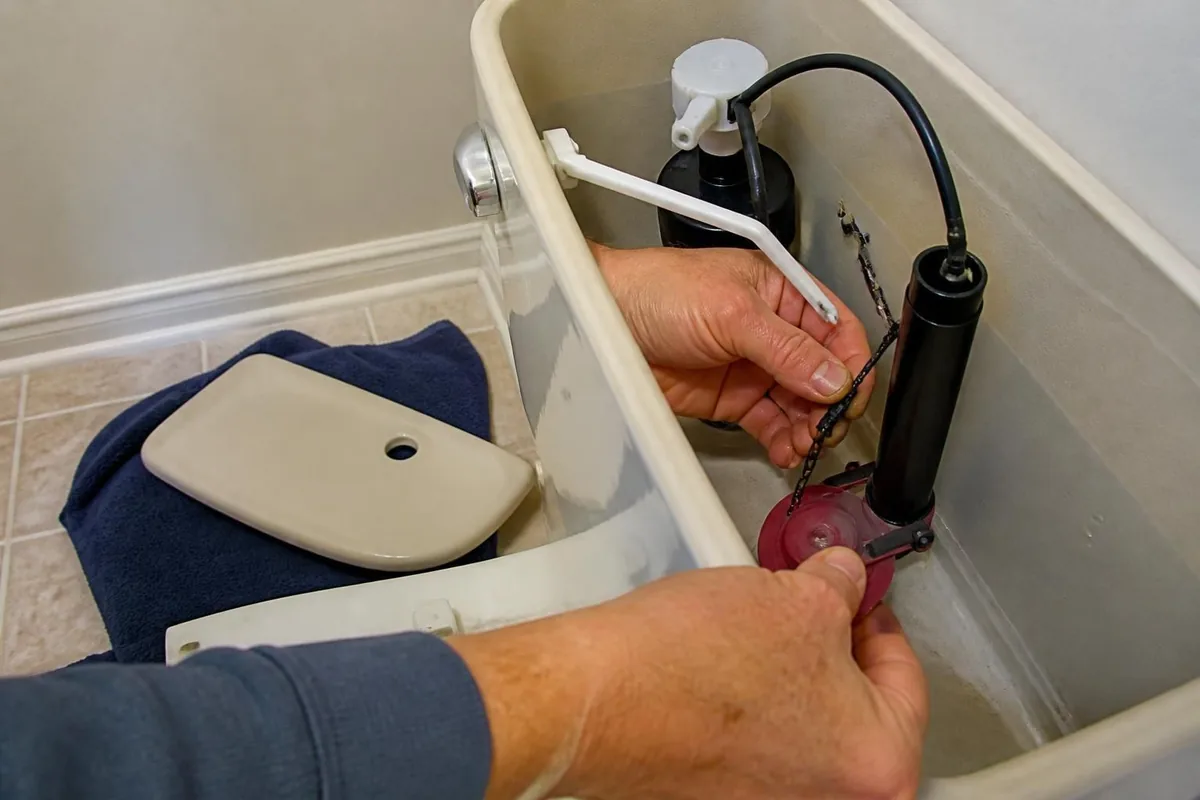
Start with a dye test
A toilet can leak from the tank into the bowl so quietly that you never hear it refill. Add a few drops of food coloring to the tank, leave it alone for about ten minutes, then check the bowl. If color shows up, water is escaping past the flapper or flush valve, and those parts are the place to start.
What each symptom usually points to
- Refills on its own between uses: the flapper is worn or warped and no longer seals.
- Water trickling into the overflow tube: the fill valve is set too high or won't shut off.
- Weak flush or double flushing: the tank water level is low, the flapper closes early, or mineral buildup is blocking the rim holes.
- Water on the floor at the base: a failed wax ring or loose floor bolts.
- Drips under the tank: tank-to-bowl bolts, the supply line or a hairline crack.
- Rocks when you sit down: loose bolts, a broken flange or soft subfloor.
When the clog isn't really in the toilet
A toilet that clogs again a day after plunging, or a tub that gurgles when you flush, usually means the blockage is farther down, in the main drain or the sewer lateral to the street. Older intown Atlanta homes can have cast iron drains and clay sewer laterals, and roots or a sagging section can catch paper and wipes. Stop flushing and have the line cleared and, if it keeps happening, looked at with a camera. If sewage is overflowing from a city manhole or the street, that is a Department of Watershed Management matter to report to ATL 311 at 404-546-0311.
Pulling the toilet
A leak at the base is fixed by lifting the toilet off and setting it on a fresh seal. While it's off, a good plumber checks the flange and the floor around it, because slow seepage can rot wood over time. That inspection matters in a city where about 43% of homes were built before 1980.
Repair or a new toilet
Replacement parts are common and easy to get, so repair is usually the better call. A cracked bowl or tank is the main reason to replace. In Atlanta, plumbing permits for new or replacement plumbing in one- and two-family homes are technical permits applied for online with the Office of Buildings, so ask whether your project needs one.
Cost factors
Price depends on which part failed, whether the toilet has to come up, the shape of the flange and subfloor, any drain clearing, and whether a new fixture goes in.
Toilet Repair questions from Atlanta homeowners
Why does my toilet refill for a few seconds when nobody has used it?
Are flushable wipes okay to flush?
Is a small puddle at the base of the toilet a big deal?
How can I tell a toilet clog from a sewer line problem?
Related plumbing services in Atlanta
Helpful guides
Toilet Repair in nearby cities and towns
Fulton County
DeKalb County
Cobb County
Gwinnett County
Clayton County
Cherokee County
Forsyth County
Paulding County
Douglas County
Fayette County
Henry County
Coweta County
Bartow County
Spalding County
Sources
Last updated: